Thursday, April 25, 2013

Volunteer Stories- United Planet

Sandy Ruiz, 22 years old, Volunteer in 2008
Describe your volunteer work experience.
I really liked the opportunity to build relationships with the other therapists, students, and patients at my volunteer site.
I also enjoyed having free time to explore Quito and surrounding areas.
I volunteered in a physical therapy clinic. I helped the therapists with whatever they needed, mainly operating different modality machines.
Tell us how you feel overall about your experience.
I went into my United Planet Quest excited, but of course a little bit nervous.
Having a solid background in Spanish, as well as previous experience in the physical therapy field, I knew I had an incredible opportunity to help my host community.
Not only did I meet some great people at my volunteer site, but outside of it as well. I came to really appreciate the Ecuadorian culture, and left with some wonderful memories. I hope to visit this diverse country again very soon!

Volunteer Stories- United Planet

Jane Hedrick, 22 years old, Volunteer in 2010
international healthcare volunteer in Peru Describe your volunteer work experience.
I played with the children and assisted in feeding, changing, and daily hygiene.
In the outpatient area I was able to triage the patients; taking heights, weight, BP, pulse, temp and giving injections.
Tell us how you feel overall about your experience.
This was one of the best experiences of my life. I was a little unsure whether or not I was making the right decision before going, but I would do it all again in a heartbeat, in fact when it was time to come home I didn't want to leave.
I lived with a host family for the entire 3 months that I was in Peru. They were so welcoming. They had a daughter the same age as me and we became fast friends. They showed me around the city and were very friendly and were always around to talk to and hang out with. They made the trip what it was for me. My "mom" also cooked 3 meals a day for us of traditional Peruvian food which was delicious. I am still in contact with them and am already trying to figure out when I can go back to visit.
The cultural activities were also amazing. Included in the Peru quest is a trip to Machu Picchu, which is an overnight trip. You take the train to Aguas Calientes and spend the night there and then head up to Machu Picchu in the morning where you have a guided tour and then time to explore on your own.
international volunteer in Peru trip to Machu Picchu
Also included in this trip was a tour of the Sacred Valley, a Cusco City Tour, and a Quechua (The Incan Language) lesson.
I also received Spanish lessons twice a week for the entire duration of my trip. The teachers were amazing. They really knew what they were doing and were so friendly and around just to chat if you wanted to as well.
The Spanish school also organized an event each week so you could meet other volunteers or travelers and hang out. Sometimes it was a movie night, or learning to make traditional drinks, salsa lessons, cooking lessons, or parties for the different holidays.
I also loved my volunteer work. I am a nurse and worked in a clinic for my entire stay. There is an inpatient part of this clinic which houses about 50 children with mental and/or physical disabilities whose parents couldn't care for them. In this area I helped with the daily care of the children such as bathing, dressing, brushing their teeth, combing their hair, and feeding as well as played with the children. In the outpatient part of the clinic I was able to do more nursing tasks such as take blood pressure, pulse, temperature, height and weight to triage the patients and give injections. I also helped with preparing supplies and filing.
Overall this was an amazing experience. I am so happy that I did it and would love to go back someday. I would highly recommend this trip to anyone.

Volunteer Stories- United Planet

http://www.unitedplanet.org/volunteer-stories-0

Sydney Yovic, 23 years old, Volunteer in Chile
What did you hope to gain from and achieve during your United Planet Quest?
To gain perspective on the world we live in as humans, to learn about medicine in other countries and also learn about the cultures in South America.
I love meeting new people and building bonds and friendships with others. I hope to learn whatever possible and to help whoever possible. I am passionate about people and the environment we live in and by going on this Quest, I hope to be a positive member of our planet.
Describe your volunteer work experience.
I worked in the rehabilitation center in the recepcion, playing with the children before their appointments.
Although I was not able to help with direct healthcare, I do feel that I was able to improve the cognitive abilities of a lot of these children. I also believe that a good attitude and a warm smile made their day better as well as eased their anxiety about being in a doctors office.
The volunteer work that I did also gave the hard working parents a small break.
What did you enjoy most about your Quest experience?
My experience in Chile was like a vacation for my soul. I did a lot of work and found myself very tired at the end of the day, but I enjoyed every single minute of it.
My host mom, Maggie Diaz, is probably the most special woman I have been lucky enough to meet. I was only with her for two weeks, but still I felt as though I learned as much from her as I learned in a semester at college. My quest with United Planet was an experience I will always cherish.
international host family in Chile
Tell us how you feel overall about your experience.
My short-term Quest to Santiago, Chile has undoubtedly changed the way I see not only myself, but the world in which we live in. From the moment my plane landed, I was surrounded by incredibly warm and welcoming people who taught me more than I thought I could possibly learn in 2 short weeks. 
The host mom I lived with will always have a big place in my heart, she made every single day a dream for me. My volunteer experience was the most fulfilling work I have ever been a part of.
The children in the rehabilitation center were bursting with spirit and life, despite their disabilities. Each day I left my volunteer site, convinced that the children had made my day better than I could have possibly made theirs.
I would recommend and encourage anyone who shares global ideals with United Planet to sign up for a Quest, I have no doubt that my first Quest won't be my last.

Volunteer Stories- NPCA

Inclusion Takes Many Forms

By LORIEN ANDERSON

Peace Corps Response Georgia 2012
Peace Corps Paraguay 2007–2009
When I think of 'inclusion' in the US we often think of Individualized Education Programs (IEP) and teachers aides in the classroom. Some talk about 'mainstreaming' children with emotional, physical, and/or educational difficulties and are appalled at the thought of a child not having access to a good education.
Many of us know that inclusion takes a number of forms, especially in other countries. I have had the pleasure of serving as an Urban Youth Volunteer in Paraguay as a Peace Corps Volunteer, and as a School Social Worker in the Deaf Schools of The Republic of Georgia through Peace Corps Response. Knowing that so many children with disabilities go uneducated in Paraguay, I was intrigued to see what government funded boarding schools for children, who are often left undereducated, would look like. There are two schools for deaf and hard of hearing children in Georgia, one in the capital of Tbilisi, and the other in Kutaisi. While the schools only admit children with demonstrated hearing loss, they do not exclude children due to emotional, physical, or educational limitations/needs.
This means that teachers often find themselves with a classroom full of students with varying levels of skill and a variety of needs. While children often have IEPs, support for implementing them is lacking. Inclusion in these schools means that each teacher has to work a little bit harder to reach each child where he is, and their peers have to be a little more patient and willing to help each other. I found the students to be incredibly accepting of each other's differences and quite patient in class. Unfortunately, many students were left bored and disengaged while their teacher worked with individual students who needed more help.
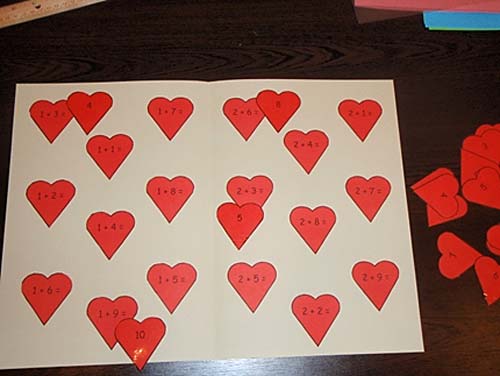
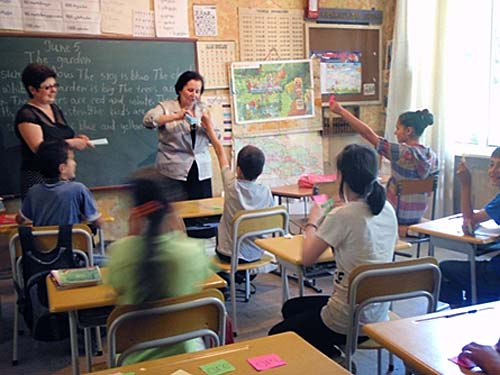
After observing numerous of these classes and therapy sessions, I saw time and again that the one thing that every student responded to was learning through play. Working with the other PCRV in the school, we launched material making sessions, focusing on visual aids and interactive learning appropriate for multi-level classrooms. The teachers at first seemed skeptical, but quickly began overwhelming us with requests. Teachers sat in the teachers' lounge with us for hours, cutting, coloring, pasting, laughing and sharing stories about their lives; it was wonderful. Teachers gladly supported each other and gave suggestions for materials. I have never felt so appreciated for doing something that seemed so simple. I developed games to use in English class and walked the English teacher through each one. She fully embraced this extremely different teaching method and her students quickly became engaged and excited. It was such a joy to see these same students who had been so bored a week before fully engaged and participating. It was equally satisfying to see what caring teachers can do given the right materials and a little guidance.
The students responded so well that the Vice Deputies of Education and Caregivers asked for more games that could be used both during and after school. It turns out that a number of people were interested in teaching through play; they just didn't really know where to start. Together, we created learning games geared towards a wide range of levels focusing on fine motor skills, math skills, identifying and organizing, and problem solving. I created binders for the Vice Deputies with copies of each of the games so that they could be easily replicated in the future, and the three of us made a commitment to each other to share ideas for additional games with each other going forward.
Anyone who has been a volunteer knows that Peace Corps is largely about building relationships. It turns out the same is true for PC Response.

Volunteer Stories- NPCA

Up the Chagres River

By KYRA STENSLIE

Peace Corps Response Panama, 2012
Peace Corps Paraguay, 2006–2008
During my Peace Corps Response service in Panama, I was warmly accepted and treated as a valuable member of my host community, just as I had been as a two-year volunteer in Paraguay. My experience serving in Paraguay was life-changing and certainly worth repeating. The fond memories and life lessons I learned from that original experience are what inspired me to apply to Peace Corps Response. I was excited to once again have the opportunity to utilize my teaching skills and share my enthusiasm for learning in a new and distinct part of the world.
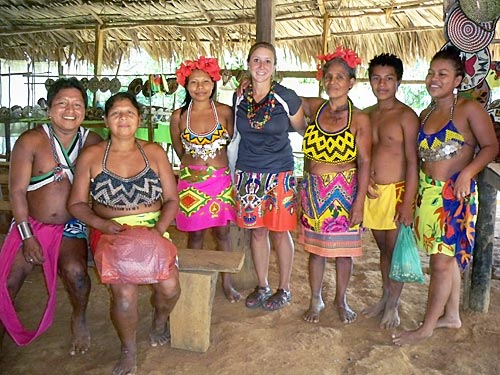
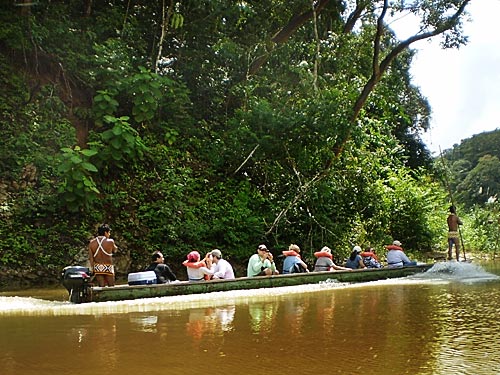
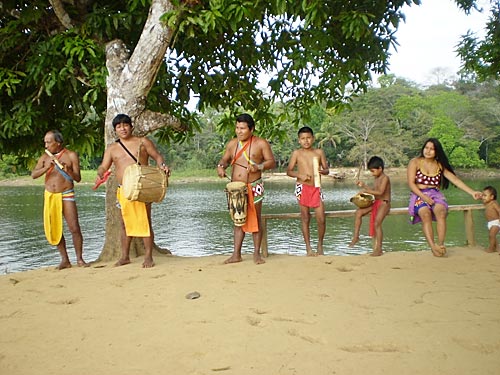
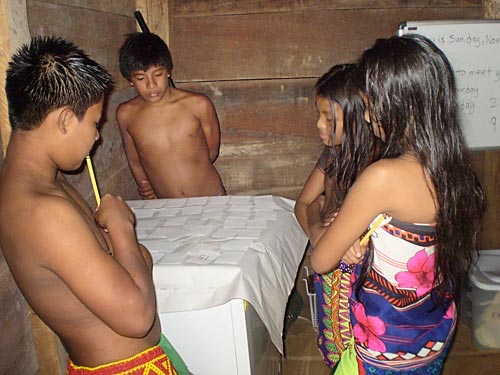
As a Peace Corps Response Volunteer in Panama, I created and taught a basic English curriculum to children and adults in an indigenous village.  The Embera tribe I lived and worked with reside on the Chagres River and depend on tourism for their livelihood. My role was to help facilitate communication between the Embera people and the daily tourists that visit their village. This was done through my daily English classes as well as informal conversation throughout their work day with tourists.
Each morning I awoke to the peace, quiet, and beauty of living in a secluded native village on the river. I quickly adapted to climbing up and down the ladder of my host family’s raised hut each day, sleeping in the fresh air on the wooden floorboards, and eating the traditional meal of fried tilapia and plantains. The quiet mornings always transitioned into busy afternoons with the arrival of tourists to the village. The Embera shared their traditional music, dance, and artisan crafts with the visitors. Living on government land prevents this tribe from growing crops, which is why they rely heavily on the income they make from tourist visits each day. In a small isolated village only accessible by dirt road and dug-out canoe, the few hours of international tourism brought a very unique clash to the otherwise remote conditions.
In addition to my daily classes, I worked in collaboration with APROCO (Asociación de Profesionales Costarricenses), a Costa-Rican organization in Panama City. My APROCO counterparts were teachers who had spent the last several years working in the Embera village in order to help promote literacy in both Spanish and the Embera language. They requested a Peace Corps Response Volunteer to aid their education work by focusing specifically on English language skills. I transferred my lesson plans and materials to my counterparts for the continuation of my teaching English project in the community.
Throughout my three months, I enjoyed watching my students progress and increase in their confidence to speak basic English. I was impressed by their motivation and desire to learn as a way to improve their education and to better share their culture with others. Being a Peace Corps Response Volunteer is an unforgettable and extremely worthwhile experience, and a brief opportunity to help make a difference. Experiencing the joys and challenges of a new culture, forming friendships around the world and seeing things through the eyes of the host community are what make a Peace Corps Response service so memorable and unique.

Volunteer Stories- NPCA

Lending a Helping Hand

By AMANDA OWENS

Peace Corps Response Antigua 2010
Peace Corps Mauritania 2006-2008

The difference between my first assignment in Peace Corps and my second one with Peace Corps Response is like night and day. Living and working in Mauritania, Africa, is vastly different from working in the Caribbean. For one thing, the needs and demands of the community are not the same. Similarly, I felt that the challenges I faced in Mauritania made my work in Antigua seem like a walk in the park.
Don't get me wrong, there were challenges in Antigua, but they were not as hard to overcome. In my first assignment, I worked as a teacher in a community that hosted Peace Corps Volunteers for over 10 years; as a result, the community knew and recognized Volunteers. In my first assignment, I also had three months of training and ample time at the site to learn about the culture, the languages, and my role as a teacher and gender and development Volunteer. As a Peace Corps Response Volunteer, you literally hit the ground running. The first time around, I had extensive training for my work in Peace Corps Mauritania; the second time around, I had six months to complete my assignment. With Peace Corps Response, I was part of a group of Volunteers serving in Antigua and Barbuda and we had five days of orientation in St. Lucia and the next week we were sent to work.
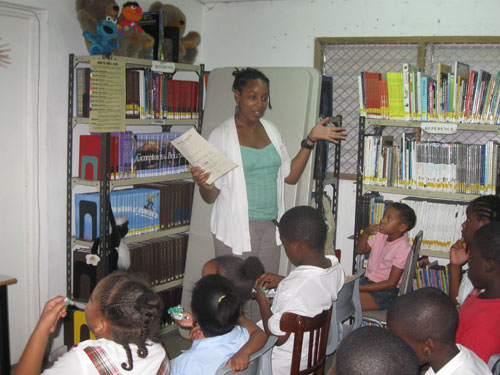
With Peace Corps Response, I served as a children’s librarian at the Antigua Public Library. This project was developed in preparation for the library's re-location to a much bigger and more central location in the city. My role was to help revamp the department and train new staff to run the department. Given the short time I had to implement, I felt really blessed to be placed in an institution that had a strong sense of the direction it needed to go to succeed.
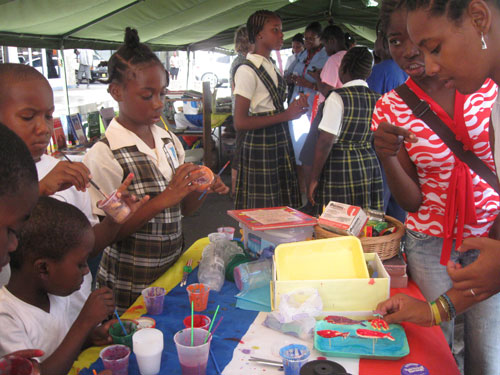
The department already had a few programs in the works, such as, Audio/visual Thursdays, Reading is Essential Program, and Friends of the Antigua Public Library Summer Reading Program. I reviewed the department’s programs, spoke with the kids to see what they wanted, and worked with staff to make it happen in the library. An important aspect of this project was moving from a strictly children’s department to a youth services department that served patrons from 5 to 15 years, and hosted activities in which all age groups could participate. We worked with what we had, and added what we could. I wanted to make the library a place not just for homework and research, but one where we could have fun with planned activities for parents and kids. In order to do this, we added monthly themes to the department, celebrated Earth Day, Best Friends Day, and other kid specific holidays. We added art and craft activities for Friday afternoons (Craft Friday). To get more involvement from the kids, we also added computer courses for the kids, and Summer Story Time.
Not only did I transition the Children's Department to the Youth Services Department, I trained two new members of the staff in the department. First and foremost, the staff was taught library basics. We worked with the adult library team on using the circulation software and on recording statistics to evaluate and monitor computer usage, new members for the month, books checked-out, and patrons late on returning books to the library. The staff and I worked together to create several new initiatives that were not previously part of the department.
Through our efforts, the department saw a huge increase in involvement from kids and parents. More and more parents became actively engaged in what their children were doing in the library and participated in the activities. Over 160 children signed-up for the summer reading program, a huge swell from the 60 kids the year before. Even as I prepared to leave, I worked with staff to create a calendar of events for the coming months.
Working with Peace Corps twice has given me the chance to grow professionally, to live in another part of the world and to realize once again how little our differences are and how many great opportunities exist to help each other. In the field, we tend to think that we are more like the “lone rangers,” but I have come to understand that without help from each other we all fail. So whether in a devastating under-developed country like Mauritania, or in a beautiful tourist spot like Antigua and Barbuda, development will only succeed with help from the community.

Volunteer Stories- NPCA

http://www.peacecorps.gov/response/volstories/

Success Doesn’t Happen Overnight

Brian Woods

Peace Corps Response Georgia 2012
Peace Corp Ukraine 2007-2009

How does one define success? This was often a topic among Volunteers during my initial service as a TEFL (Teaching English as a Foreign Language) Volunteer in Ukraine. Like many of my peers, I dreamed of instant results, but I was pragmatic enough to know that I was playing the “long game.”
After finishing my first assignment with Peace Corps, I pursued a master’s at Ohio University in Communication and Development. What I learned about social geographies, empowerment and social change while in school greatly impacted how I understood the world. During my last quarter of school, I began the Peace Corps Response (PCR) application process. In 2012, I started my assignment in Georgia where I worked at a women’s health clinic as an Organizational Development and Advocacy Specialist. My director, Marika Davituliani, had been playing the “long game” already.
Marika is a strong and determined woman. She is a medical doctor by training. Every day, she sat with patients and counseled them on possible treatments and options. In the late ’90s, Marika recognized a problem: too many women in Georgia were dying from breast cancer. According to the 2010 Statistical Yearbook published by the Georgian National Center for Disease Control, 55% of breast cancer cases were diagnosed in Stages 3 and 4. Of those diagnosed, 17.5% died in the first year.
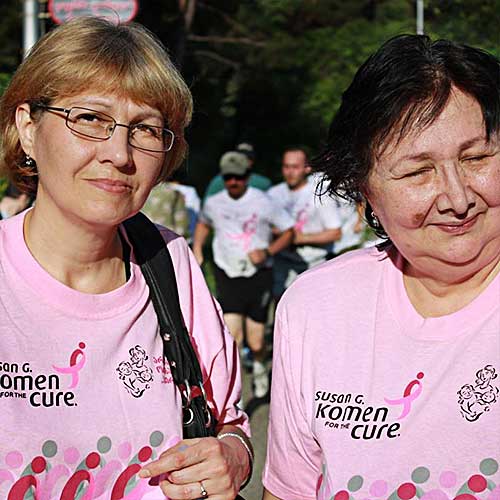
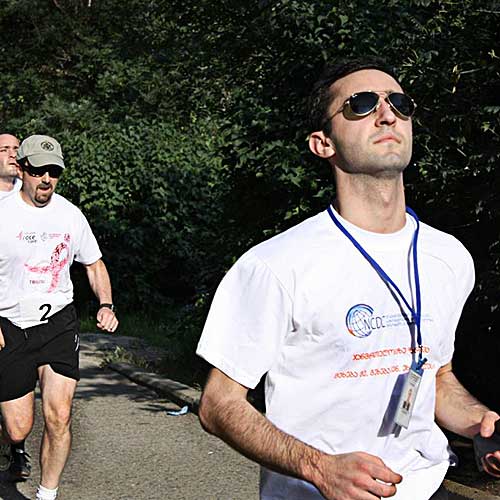
Marika was seeing these statistics as her patient’s lived them. In 2001, with other female physicians, Marika founded Women’s Wellness Care Alliance HERA in order to promote breast cancer awareness. Within a few years, their team organized their first breast cancer race in Kutaisi, Georgia’s “second city.” These efforts attracted the attention of Susan G. Komen for the Cure. Soon the race was part of Komen’s network and moved to the Georgian capital of Tbilisi.
With all this success, why did HERA need a PCR volunteer? The answer to that lies in Georgian society; Georgia is a socially conservative country so issues such as breast cancer can be very sensitive.
From my experience, this issue makes HERA’s work more difficult. First, it is not common to talk publicly about things that they consider of a sexual nature, like breast cancer. Women who are diagnosed with breast cancer are generally hesitant to talk about their experience with others. Women-specific issues are not often at the forefront of the conversation. The Georgian government recognizes the public health challenge, but has limited resources available to address them. Those resources also have to sustain an entire country struggling with the transition to a 21st-century, global economy.
In addition, funding is the biggest problem HERA faces. The organization has ambitious outreach plans, but faces many obstacles when competing for international donor funds. While there are many challenges, HERA still fights for their cause and measures success in the number of women who triumph over cancer.
My work with HERA centered on enhancing the organization’s profile while helping them think farther into the future. They were an organization that existed locally in Kutaisi, but had a national presence because of the annual race. I saw an opportunity to strengthen local connections. I helped broker a meeting between Marika and Kutaisi’s city administration. The gentleman with whom we met had a relative who had died from women’s health issues, so he proposed signing a letter of cooperation that grants HERA access to some of the city’s resources. We also reached out to Georgian celebrities. Some did express an interest in working with HERA in the future. HERA recognized the need for a more robust online presence. We reworked their Facebook page and developed a new bilingual website with information that could be useful for both Georgian and English speakers.
I also worked with HERA to draft a strategic plan so that the ideas generated were codified in a meaningful way. I reminded them that none of our successes and failures were an end. If someone said “no” to partnering today, they needed to be asked again tomorrow. If a grant idea didn’t work, it needed to be rethought and resubmitted. If turnout at an event didn’t meet expectations, the promotion of that event needed to be rethought instead of the event being abandoned. I emphasized that it isn’t “this didn’t work,” it’s “this didn’t work today.”
Although my service ended this past September, I am still HERA’s “advocacy specialist” I believe in their vision to bring an end to breast cancer as a life threatening illness in Georgia. I am proud to have served such a powerful and determined group of women.